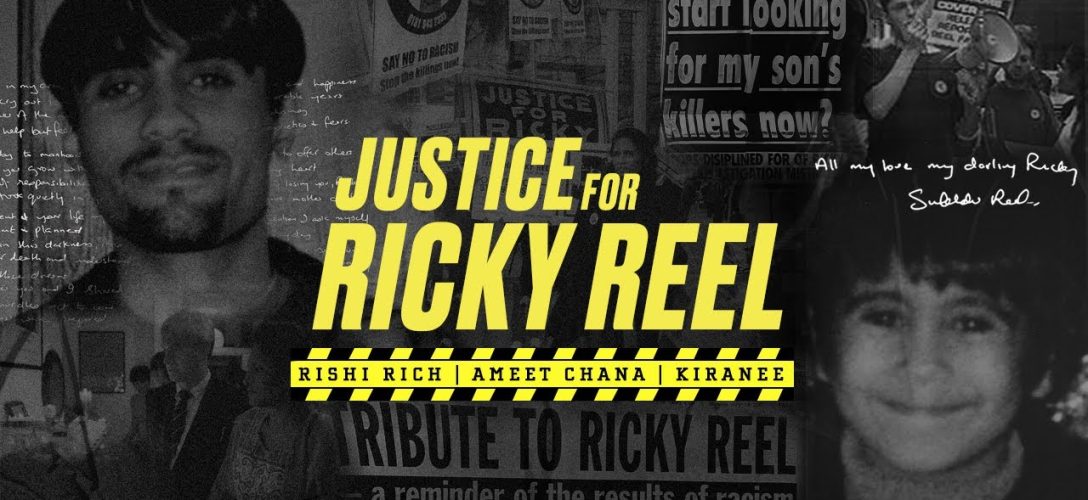

On 14th October 1997, Lakhvinder ‘Ricky’ Reel, a 20-year-old student from London, went for a night out in Kingston with his three Asian friends. They were attacked by two white youths shouting racist abuse which ended in an altercation where actual physical blows were exchanged. The three friends regrouped, but Ricky was never seen alive again
Ricky was reported missing immediately at Uxbridge police station who refused to take a statement. Police made some serious mistakes. The police at Kingston also refused to take a statement even from the three friends who were attacked that night thus ignored the racist attack. They assumed that Ricky had run away from home. They assumed young Asian children could not have open and honest relationships with their parents.
The investigation started on the assumption that Ricky must have run away from home to escape an “arranged marriage”, or he must have been gay and therefore scared to “come out” and had run away. There was not a shred of evidence to support these assumptions. Everything they did from that point on was coloured by these assumptions and they absolutely refused to take seriously the racist attack which was the last time Ricky was seen alive. The racial attack which resulted in his murder was totally ignored
Because the police refused to investigate our case we the family and supporters had no choice but to investigate it ourselves. We located CCTV cameras and asked the owners to preserve it so that the police could seize it, we leafleted for witnesses, even arranging our own appeal on crime watch.
The river was one place we could not search. We had begged the police to search the river. When they finally searched the river on 21st October 1997, they found Ricky in just seven minutes.
The Chief Police officer at the scene decided it was just a tragic accident and decided to close the case at the river. No forensic tests were conducted of the site or his clothes.
The Police broke the news of their brother’s death to the other siblings without parents present. They told them in the coldest police terms “we found your brother’s body at the bottom of the river” and then went and stood in the corner of the living room, cracking jokes, whilst Ricky’s younger sister had an asthma attack. His brother was only 11 years old, just a child, but his childhood was destroyed by this insensitivity.
At the Inquest in 1999, the Police argued the Ricky death was an accident. However, the Jury did not accept this and returned an open verdict. The four pathologists involved in the case agreed that third party involvement in Ricky’s death could not be ruled out. There were blunt impact injuries on Ricky’s back, a tear to his shirt on his shoulder, and injuries to the trunk of his body.
The family had been concerned how Ricky’s body had deteriorated in the two weeks before his funeral. Two years later at the Inquest the family discovered that the Police had commissioned a second post-mortem without their consent, and stripped Ricky of all his skin, yet another erosion of his dignity and disrespect to the family.
John McDonnell MP reads some of the Police Complaints Authority report out in Parliament. He said ‘“I simply want to place before the House some of the findings of the PCA report. Lessons must be learned from that report… overall, the report condemns the investigation because it lacked focus, it eliminated the racial incident earlier in the evening too readily, it lacked thoroughness, and there was a failure to initiate an early reconstruction of what happened that night. There was also confusion over the ownership of the investigation of the racial incident. The investigators concluded accidental death before there was corroboration, and there was a failure to adopt policies that would have ensured that professional standards were maintained in the detail of the investigation….”
We then discovered that the Chief officer in the case who had taken early retirement when he was heavily criticised for his role in the investigation had copies of material from the live investigation, including photographs taken at the inquest, in his house and was approaching journalists to write his story together with these photographs. This was reported to the Police who seized this material and handed the case to the Crown Prosecution Service. They failed to act.
In 2018 we discovered that all the time we had been asking the police to investigate this case properly they had in fact been spying on us. Police Officers from the Special Demonstration Squad had followed us, listened to our conversations and written reports about us. After a series of meetings and letters we eventually received of some these files. I had to sign a restriction order which forbids us to discuss its contents with anyone else. One day we may receive the remaining surveillance reports about us.
Our family were reassured that they were not being invested directly, it was merely “collateral damage” to a larger investigation. This investigation is now subject to the Undercover Policing Inquiry. For us it merely compounded our grief and brought back the nightmare we had suffered and continue to suffer. These resources could have been spent to find Ricky’s killers.
This year Ricky would have been 44, probably married with children of his own, a successful career in IT, but we will never know. Ricky’s case has changed policing policy – the Missing Person’s guidelines and Family Liaison officer guidelines and training were all redrawn due to Ricky’s case. But it is not enough.
102,071 people have signed our petition and joined us to demand a fresh investigation from the police – because so much has changed since Ricky’s death. Science and forensics are more advanced, and witnesses who weren’t willing to come forward back then, might well be willing to come forward now.
Please help us remind the police that this is not a “problem” that will go away – they are responsible, and they must find a way to get to the truth

 Justice For Ricky Reel